The straight truth about early-career hiring
You Hate Your First Real Job:
Don't Just Quit.
Career advice for recent grads. And the parents helping them. A direct, unsentimental look at how hiring actually works, and why your next move matters more than your last one.
In paperback, hardcover, and e-book. On Kindle, Apple Books, Barnes & Noble, Kobo, Bookshop.org, and more.
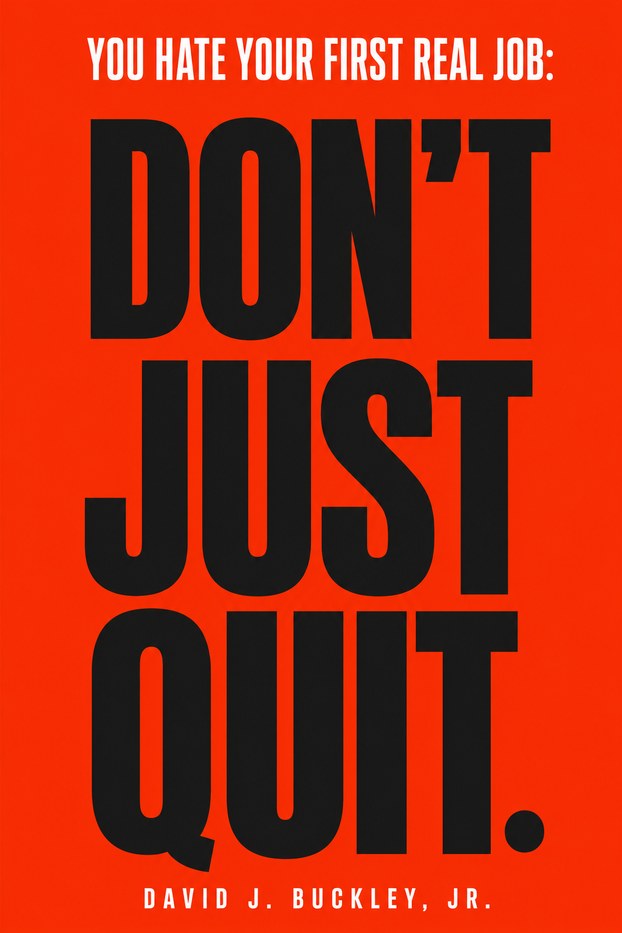
Free Kindle giveaway
Win a free Kindle copy on Goodreads.
100 Kindle copies of You Hate Your First Real Job are up for grabs on Goodreads. Enter in one click; winners are drawn automatically.
Goodreads Book Giveaway
You Hate Your First Real Job
by David J Buckley Jr
Giveaway ends September 30, 2026.
See the giveaway details at Goodreads.
Where to get it
Three editions. Every major store.
E-book — get it at





Print — get it at


Amazon, Kindle, and all related logos are trademarks of Amazon.com, Inc. or its affiliates. Apple Books is a trademark of Apple Inc. All other retailer names and logos are trademarks of their respective owners.
Who this is for
Two readers. One system.
You did what you were told, and it isn't working.
You took the first job and came to dread it. Or you settled because the rent was due. Or you have been applying for months, wondering what is wrong with you. This book explains why the qualified candidate keeps losing to the convenient one, and what to do about it without torching your story.
You want to help without making it worse.
The instinct to remove the pain and take control is natural, and it usually backfires. This book shows why, and what a genuinely useful role looks like when your kid is stuck in a bad first job or stalled in a search you are helping pay for.
Hiring is risk reduction under time pressure.
The person reading your application is not searching for your potential. They are trying to avoid a bad decision they will have to defend later, and they are doing it in seconds. Once you see that clearly, most of what felt personal and confusing starts to make sense.
Headline
Your most recent role is the frame through which everything else about you gets read.
Thread
The line of continuity that makes your next step look plausible instead of a leap.
Rhyme
A role rhymes with the one you want when a reader can glance at it and see the target.
Alignment
Not perfection. The moves that make a trajectory readable, and make it compound for you.
What you'll learn
How the market actually reads you.
Why the job market rewards the employed. Being in a role changes how every application is read, before you say a word.
Why quitting without a plan is expensive. A gap becomes a question, and the question follows you into every interview.
How to find the thread. The part of your current work that resembles the work you actually want next.
How to think two jobs ahead. Small structural choices early compound into a trajectory other people can see.
How to explain the move out loud. Perception, not intent, drives outcomes, so the story you tell has to hold up.
Common questions
Questions grads and parents ask
What should I do if I hate my first job?
The first move is to stay employed while you plan your exit, not to quit and figure it out later. The job market treats an employed candidate as a lower-risk hire than an unemployed one, so a job you dislike is still leverage. Use it to line up the next role before you leave, and choose that next role so it reads as a logical continuation of your story rather than a reset.
Is it bad to quit your first job after six months?
Quitting a first job after six months is rarely fatal, but quitting without a next step is what actually hurts you. Hiring managers read short stints for the story they tell: a six-month role that leads into something related looks like a deliberate move, while a six-month gap with no explanation looks like a question. The damage comes from the unexplained break, not the short tenure itself.
How do I explain a short or bad first job on my resume?
You explain a short or bad first job by naming the thread that connects it to what you want next. Hiring is pattern recognition under time pressure, so a resume works when each role looks like a continuation of the last. Frame the early job around the skills and direction it gave you, then show how the next move builds on that line, so the reader sees momentum instead of a detour.
Why does being employed make it easier to get hired?
Being employed makes you easier to hire because employment is a signal that someone else already took the risk on you. Hiring is fundamentally risk reduction, and a candidate another company currently trusts reads as pre-vetted. That is why the job market rewards the employed: your current role, even a bad one, lowers the perceived risk of hiring you.
Should my new graduate take a job they do not love just to be employed?
A placeholder job is usually worth taking, as long as it is chosen with the next move in mind. Any role that keeps a graduate employed protects their story and their optionality, but a job picked at random can rewrite that story in a direction they did not want. The goal is not a perfect first job; it is a first job that points somewhere.
How can parents actually help a graduate who hates their job?
Parents help most by understanding the system their child is navigating rather than pushing them to quit or to hold on indefinitely. Early-career hiring runs on risk aversion, narrative, and pattern recognition, and parents are often part of the decision because they are paying or advising. This book gives both readers a shared, realistic vocabulary for the next move instead of competing gut reactions.
What is the book “You Hate Your First Real Job” about?
It is a direct, psychologically informed guide to how early-career hiring actually works. Written for recent graduates who hate their first job, settled, or cannot find work, and for the parents helping them, it explains why hiring is risk reduction under time pressure and how to make your next move so it reads as a continuation rather than a question. It trades motivational advice for the real mechanics of getting hired.
Who wrote it, and where can I buy it?
The book is by David J. Buckley, Jr., published by Harbormen Press. It is available in paperback ($16.99), hardcover ($26.99), and e-book ($6.99) on Kindle, Apple Books, Barnes & Noble, Kobo, and Bookshop.org.
Don't just quit. Make the next move right.
Available in paperback, hardcover, and e-book. The e-book is $6.99.
E-book $6.99 · Paperback $16.99 · Hardcover $26.99. On Kindle, Apple Books, Barnes & Noble, Kobo, Bookshop.org, and more.